Skip to contents

Preamble

The most practical use for a DLBCLone model is to infer the class/subtype of samples based on the genetic features present. This is accomplished with the DLBCLone_predict function. This tutorial assumes you will start with a previously saved model, which you will restore from disk and re-activate as shown in the previous tutorial.

predicting the class of a single sample

In this demonstration, we’ll use our model to predict the class of one of our training samples. This is not the normal, or particularly sensible, application of DLBCLone but it’s a convenient way to demonstrate how DLBCLone_predict works. Since we’re using a sample that was in the training data, we can directly recycle the genetic feature matrix from the model via all_features_optimized$features. Because there are meta-features in that data frame, we also need to enable the drop_extra feature.

test_sample = "00-14595_tumorC"

pred_train <- DLBCLone_predict(
  mutation_status = all_features_optimized$features[test_sample,],
  optimized_model = all_features_optimized,
  drop_extra = TRUE
)

knitr::kable(head(pred_train$prediction))
sample_id predicted_label confidence other_score neighbor_id neighbor distance label other_neighbor vote_labels weighted_votes neighbors_other neighborhood_otherness other_weighted_votes total_w pred_w V1 V2 .id EZB_NN_count MCD_NN_count ST2_NN_count N1_NN_count BN2_NN_count Other_NN_count top_group EZB_score MCD_score ST2_score N1_score BN2_score Other_score top_score_group top_group_score top_group_count Other_count by_vote by_vote_opt by_score score_ratio by_score_opt DLBCLone_w DLBCLone_wo
00-14595_tumorC EZB 1 0 DLBCL11584T,CLC03456,DLBCL11428T,05-32762T,LY_RELY_116_tumorA,99-13280T,05-25439T,QC2-32T,SP193546,SP193976,14-20962T,FL1018T2,10-36955_tumorB 1112,351,995,85,1265,416,80,1322,1182,1164,247,89,172 0.203,0.223,0.231,0.259,0.265,0.293,0.297,0.306,0.321,0.34,0.345,0.349,0.352 EZB,EZB,EZB,EZB,EZB,EZB,EZB,EZB,EZB,EZB,EZB,EZB,EZB EZB 46.055835675141 0 0 0 46.05584 46.05584 -3.826784 2.487499 1 13 0 0 0 0 0 EZB 46.05584 0 0 0 0 0 EZB 46.05584 13 0 13 EZB EZB Inf EZB EZB EZB

Visualizing a the neighborhood of a single classification

make_neighborhood_plot

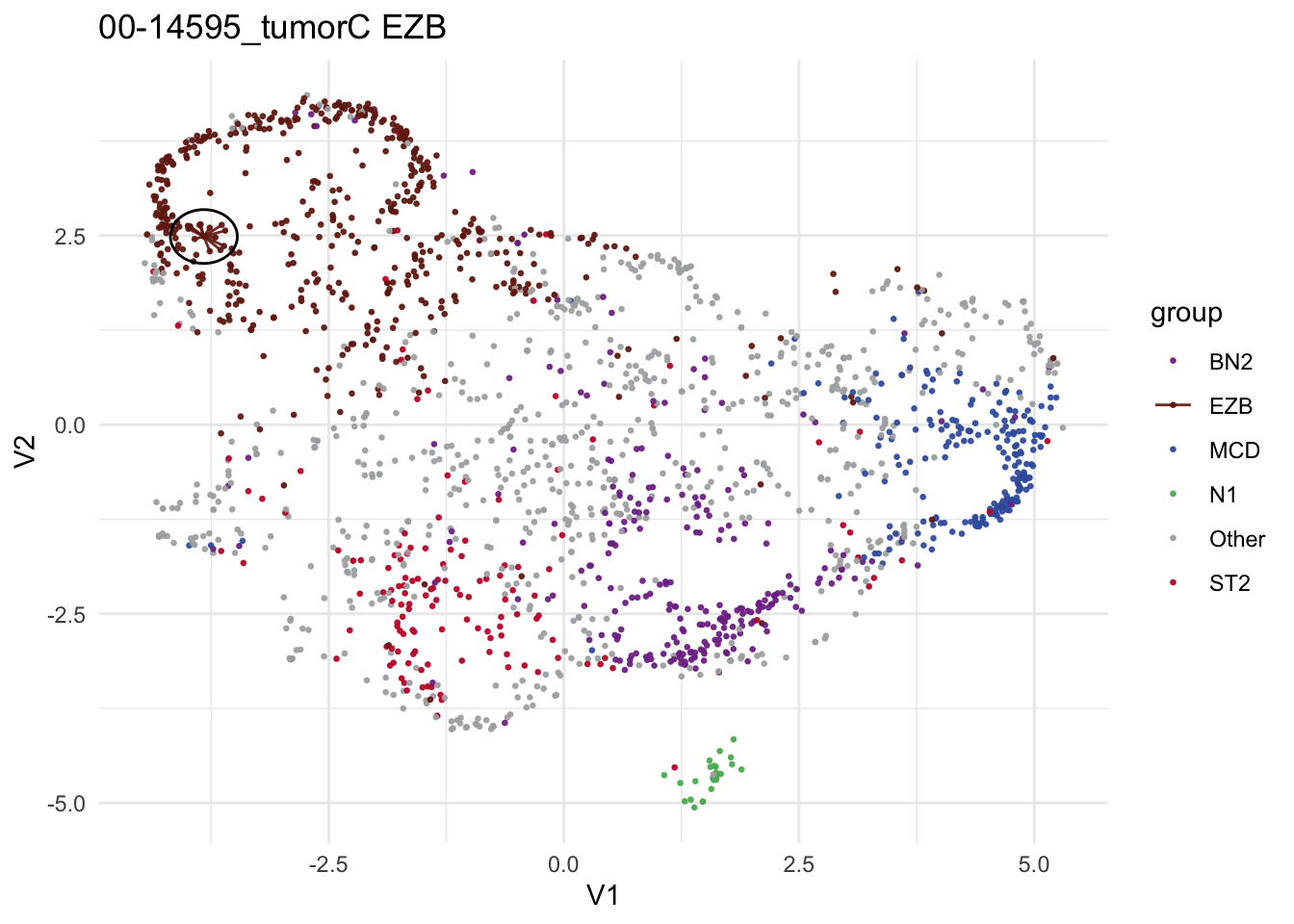
Used for visualizing how and where neighbors are selected, a umap plot is produced showcasing the test sample of interest and its trained neighbors that helped determine its labeling.

single_sample_prediction_output output list from predict_single_sample_DLBCLone

training_predictions training predictions from DLBCLone_optimize_params (e.g. optimized_model$df)

this_sample_id Character the sample ID for which the neighborhood plot will be generated

prediction_in_title if TRUE: includes the predicted label in the plot title

add_circle Plot will include a circle surrounding the set of neighbors, helpful for identification

make_neighborhood_plot(
  single_sample_prediction_output = pred_train,
  this_sample_id = "00-14595_tumorC",
  prediction_in_title = TRUE,
  add_circle = TRUE,
  label_column = "DLBCLone_wo"
)

nearest_neighbor_heatmap

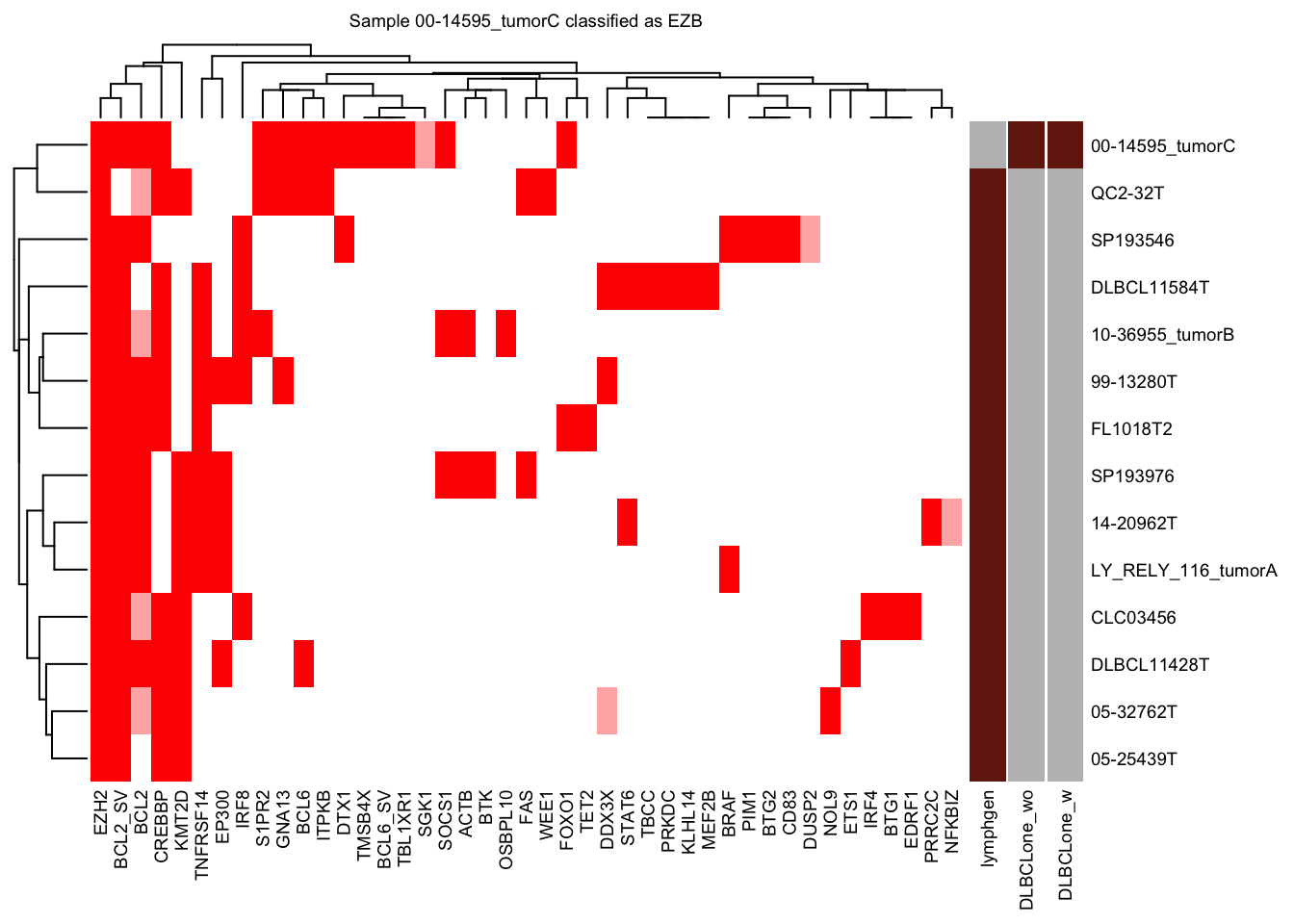
Generates a heatmap of feature values for the nearest neighbors of a specified sample, based on a DLBCLone model object. This visualization helps to inspect the feature profiles of samples most similar to the query sample.

this_sample_id the sample ID for which to plot the nearest neighbor heatmap

DLBCLone_model a DLBCLone model object, which can be the output of DLBCLone_optimize_params, DLBCLone_KNN, or DLBCLone_predict

truth_column the column name in the predictions data frame that contains the ground truth labels (default: “lymphgen”)

metadata_cols optional character vector of additional metadata columns to include in the heatmap annotations

clustering_dis the distance metric to use for clustering rows (default: “binary”)

font_size font size for heatmap text (default: 14)

nearest_neighbor_heatmap(
  this_sample_id = "00-14595_tumorC",
  DLBCLone_model = pred_train,
  font_size = 7
)